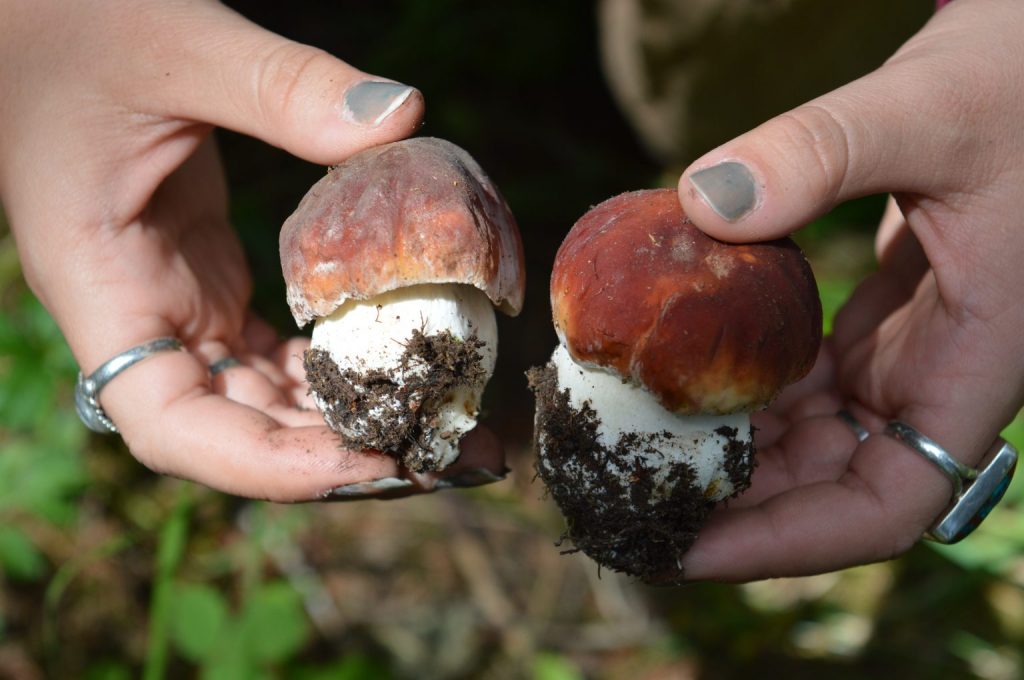
This past Tuesday night, October 8th at Biedermans, PSU held its second session of Pints with Professors. Titled “Sustainable Ethics of Wild Mushroom Foraging: where’s the beef?,” research faculty member and owner of Mad Professors Mushrooms LLC, Thomas Stoughton, lead the event. The discussion’s focus was to give advice about how to hunt and forage for mushrooms, and in the process leave no trace.
First and foremost, Dr. Stoughton informs us of our personal responsibility to know the lands we are collecting specimens on. He elaborates that, “the philosophy regarding landowners is to get out on the right foot. Make sure you’re in the know about what and where you are collecting– even if the land isn’t posted.” He explains that three years ago, when he contacted the National Forest Service to inquire about a commercial harvesting license, they responded to him saying they have never received a similar request. The important piece here is communication between yourself and landowners, no matter if there isn’t any ongoing discussion or you think what you’re doing is okay.
Dr. Stoughton spoke about different types of ethical concerns that people should know about. First off, he says that communication between ourselves and landowners is important. Sticking to the trails in natural forest areas helps to minimize and localize footprints. When physically interacting with environmental specimens, Dr. Stoughton says that it doesn’t matter how you get it out of the ground; you can either pull or cut it out with a knife. However, the goal is to prevent as much damage possible when collecting forest fungus. He also says that foragers should practice ecological kindness, and only take a small percentage of a specimen you might find so that it can be appreciated by others as well. Finally, if you are going out into the wilderness this time of year then you should wear orange to be safe, as it is hunting season.
If you’re a person that doesn’t like mushrooms then you’re not alone. Dr. Stoughton informs us that European colonizers that came to America have made our society “fungo-phobic.” Interestingly, most mushrooms that are sold in stores are the least appealing, but are simply easiest to grow. Cremini, Portabella and White Button Mushrooms are all the same Mushroom species, Agaricus bisporus, but each are just in different growth stages. Mushroom diversity extends far beyond what we see in the grocery store selection.
Fungi form symbiotic relationships with plants. This means that certain mushrooms only grow near (and with) certain trees. For this reason, if you’re interested in searching for mushrooms yourself, then it’s important to know your trees. Dr. Stoughton provided insight that, “multiple trees have multiple mycorrhizal relationships depending on the seasons.” This means that Hemlock is a decent habitat to find mushrooms no matter the time of year. A fun fact that Dr. Stoughton spoke of is that, surprsingly, fungi share more common with humans than they do plants!
Dr. Stoughton is currently working on collecting data on where people like to forage, what they are foraging, and how much they are foraging. Stoughton wants to use this data to help better regulate commercial foraging. If anyone can provide any data or has an interest in starting to forage mushrooms, please send me an email at rcroberts@plymouth.edu.
TAGS: MUSHROOMS, PINTS WITH PROFESSORS

Leave a Reply